Most school comic projects ask for the same thing: a short strip, four to six panels, that tells a story or explains a topic with a beginning, a middle and an end. The drawing counts for less than you'd think. What a teacher is looking for is a story that's easy to follow and facts that are right.
Here's how to plan one so it's finished on time, on paper or in a studio like ours.
Read the assignment first
Before you plan anything, find three things on the sheet:
- How many panels. Four to six is the usual ask. If it says six, plan six.
- What it's about. A book you read, a moment in history, a science idea, something that happened to you.
- Whether the drawing is part of the mark. If the teacher wants your own drawings, the drawing is yours to do. If the mark is for the story or the topic, ask whether a drawing tool is allowed.
Pick one idea, and give it someone to follow
A comic about "the water cycle" is a list. A comic about one drop of water trying to get back to the sea is a story, and it covers the same facts. Pick one thing that happens to one character.

The character can be a person, an animal or the thing you're studying: a drop of water, a Roman soldier writing home, a seed. If the project is about a book, it's someone from the book.
Beginning, middle, end: one panel a beat
Write the story as beats before you draw anything. A beat is one moment the story can't do without. For a four-panel strip:
- Beginning. Who, where, and what they want.
- Problem. Something gets in the way.
- Turn. They try something, or find something out.
- End. How it comes out, and what it means.
Six panels give the middle two more beats: a first try that fails, and the moment it gets worse. That's what the extra room is for. If you count seven beats, two of them belong in one panel.
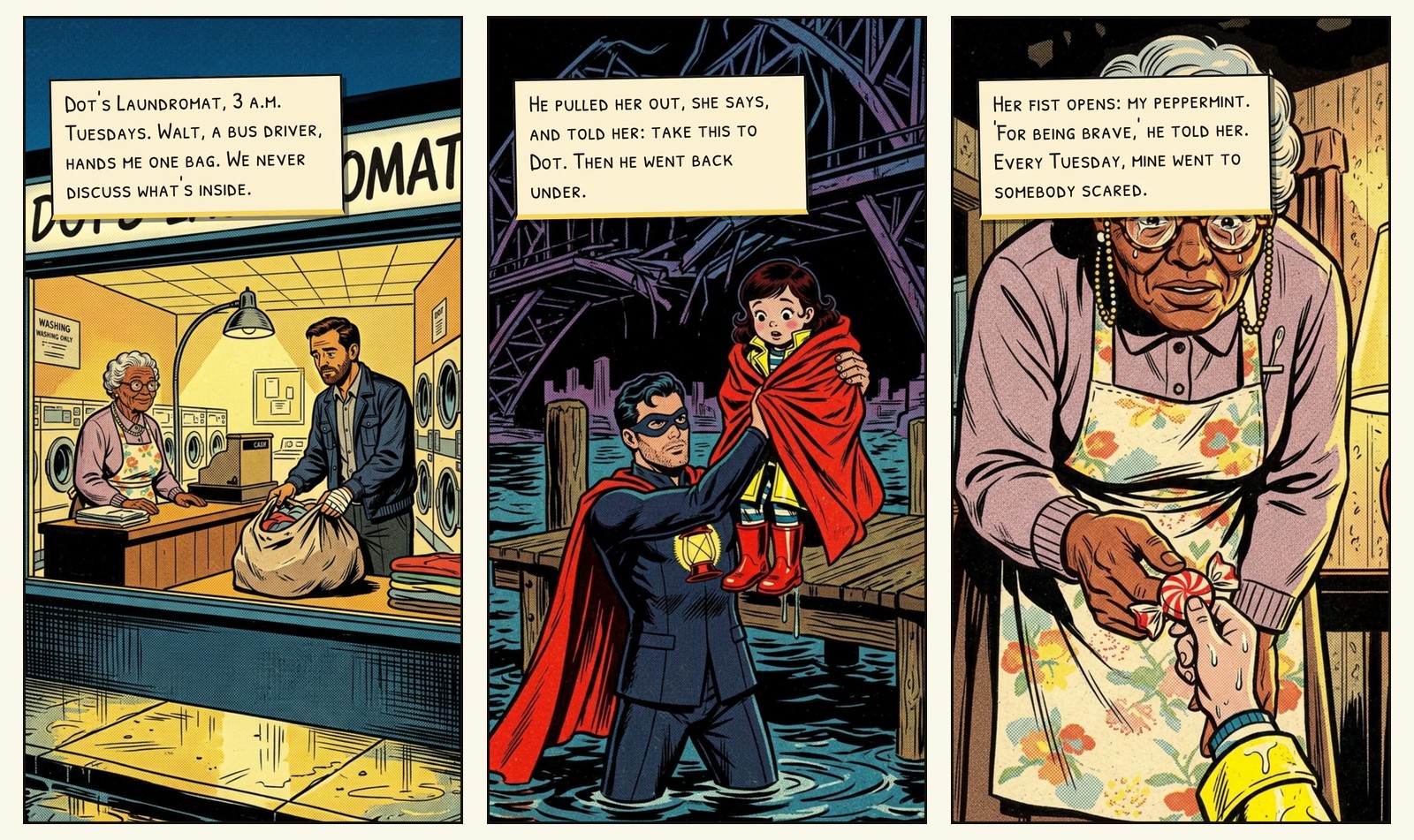
Our own comic, Wash & Fold, runs eight panels an issue, but its first issue tells its whole story in these three: who and where, what happened, what it meant. Each panel is one moment, with one caption.
Keep the words short
A panel is a picture first. Give each one a caption of a sentence or two, or a short line of speech, and let the picture show the rest. If a caption only says what's already in the picture, cut it. Comic lettering basics covers how many words a panel can hold.
For a topic comic, put one fact in each panel, not three. Read the facts out loud before anything is drawn: a wrong fact is easier to fix in the words than in the picture.
Sketch it before you finish it
Do a rough version first: boxes, stick figures, the words in pencil. Read it to someone who hasn't seen it. If they can tell you what happened, the strip works. Then do the neat version. How to write a comic script shows what to write down for each panel before it's drawn.
Making it with Panel & Ink
Panel & Ink writes and draws a comic from one idea. Here's what that looks like for a school project, and where its limits are.
Who makes it. Accounts are for people 13 and over. For a younger class, a teacher or a parent makes the comic, with the kids choosing the story. Older students can make their own, if their teacher allows it.
Kid-safe from the start. Every comic has a rating, picked on the first step. Everyone is already chosen: warm and kid-safe, nothing frightening or cruel, no bad language.
The plan is the premise. Write the idea the way you planned it above: the character, where they are, what has to happen. The writer works from it, and you read the script before a single panel is drawn, so a wrong fact gets fixed there.
Real people. Describe the characters in words and the studio draws them. If you add a photo of a real person, the studio first asks you to confirm you have their permission. For a class comic, leave the students' photos out.
How long. A Panel & Ink issue is six to eight panels; the writer settles the number from your story. If the assignment asks for exactly four, the plan above works just as well on paper.
Handing it in. A finished issue downloads as a narrated video to play on the whiteboard, or as its panels in a zip with the captions, ready to print. You can also turn on a share link: anyone with it can read the issue, and turning it off closes it again.
Where to start
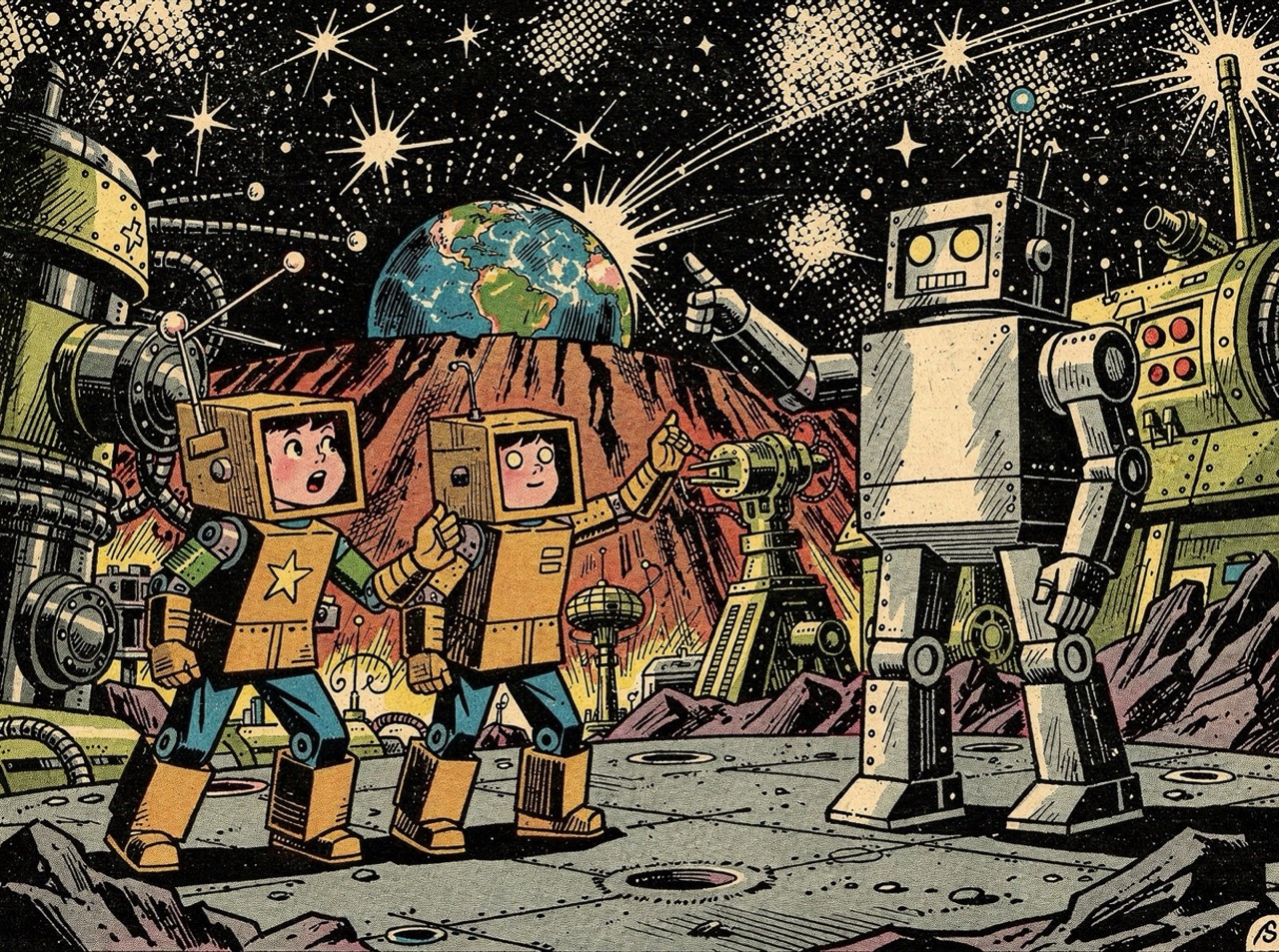
A classroom comic turns a lesson into a story, rated Everyone. Science for kids takes one topic an issue: a volcano, the water cycle, the moon. For a story small enough for a few panels, comic strip ideas for beginners has premises to borrow, and how long is a comic issue shows how to count beats.
For the look, Sunday Funnies is a cheerful newspaper strip, and Ligne Claire draws clean, clear pictures where you can see what's going on.
What it costs
An issue on a standard look runs about 20 credits. A new account starts with 35 credits, enough for your first issue on a standard look, and they last 14 days.
Make your first issue: one idea, a beginning, a middle and an end.